How to Actually Finish a Side Project (For Once)

What IS finishing, anyway?
I mean really. Think about it. Is anything ever truly done? An app could always have one more feature. A novel could always use one more edit. Even shipped products need updates, patches, version 2.0.
Maybe you haven’t been abandoning projects. Maybe you’ve been releasing them into their natural state of incompleteness.
That half-built app on your hard drive? It’s not unfinished. It’s free. Free from the burden of expectations. Free from scope creep. Free from ever having to deal with user feedback.
You’re not a quitter. You’re a liberator.
Of course, that’s complete rubbish. But it felt nice for a second, didn’t it?
Skip the jokes, just tell me what actually worksThe Momentum Problem
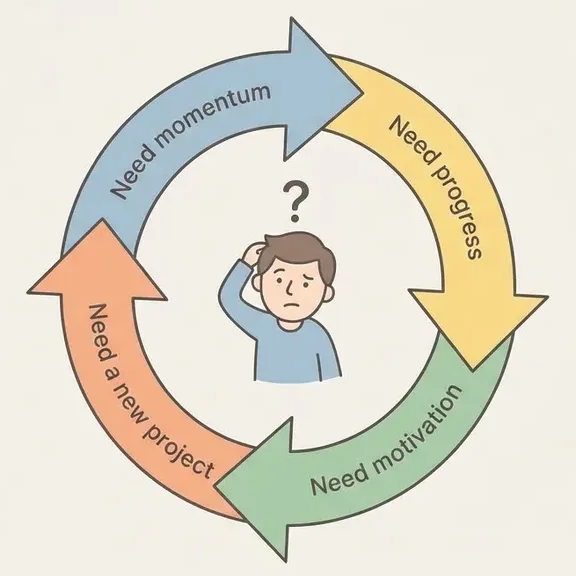
To finish a project, you need momentum.
To get momentum, you need to make progress.
To make progress, you need to want to work on it.
To want to work on it, you need… a new project.
Wait. That’s not right.
But that’s how it feels, isn’t it? The excitement of starting something new is almost chemically addictive. Day one of a new project and you’re invincible. You’ve got ideas. You’ve got energy. You’ve got that dangerous feeling that this time will be different.
By week three, the shine has worn off. You’ve hit the boring bits—the fiddly details, the parts that don’t spark joy but need doing anyway. And somewhere, in the back of your brain, a tiny voice whispers: What if you started something else? Just to take a break. Just to refresh your creativity.
That voice is a liar. A very persuasive liar.
The new project doesn’t refresh you. It just moves the problem sideways. Now you have two unfinished things. And in three weeks, you’ll be bored of the new one too, and ready to start a third.
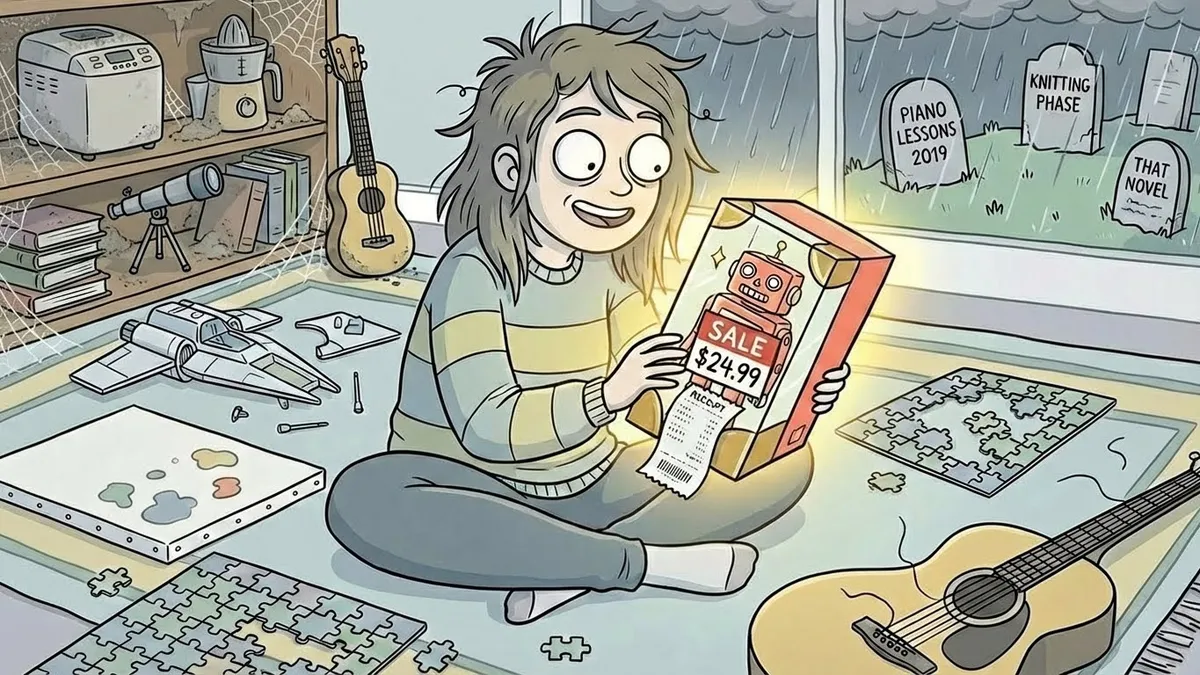
This is how people end up with eleven half-finished novels, six abandoned apps, and a shed full of woodworking projects that are “almost done.”
Skip the jokes, just tell me what actually works
A Brief History of Finishing Things
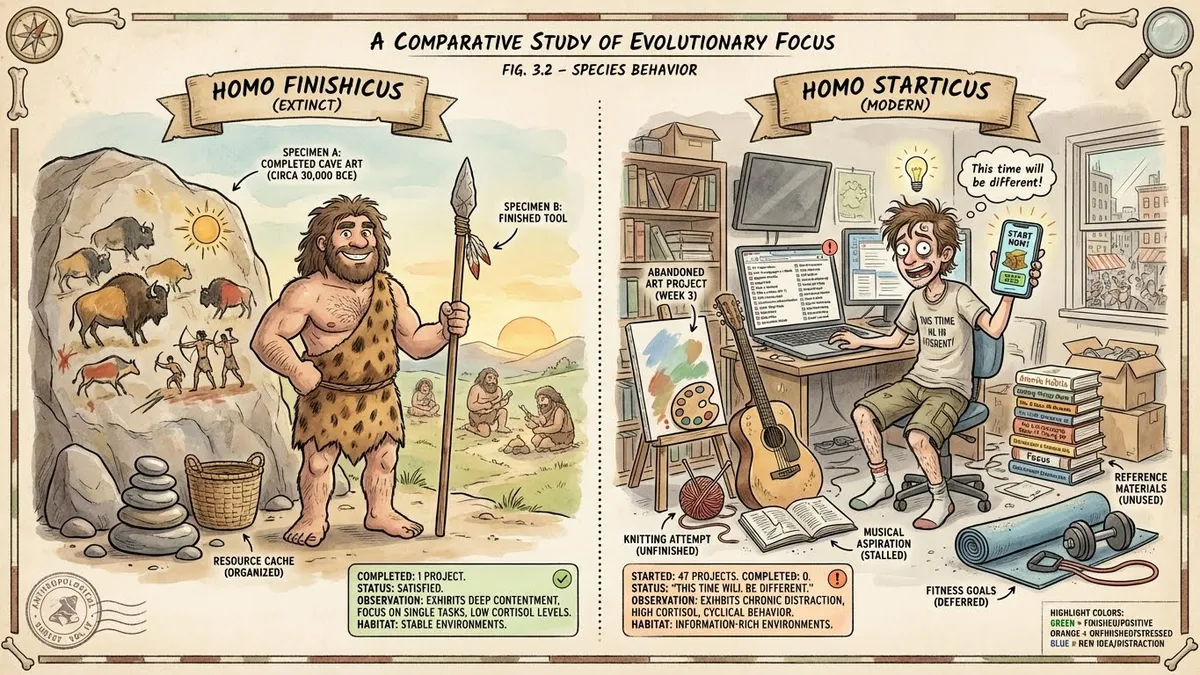
Scientists have identified two distinct species in the genus Homo Projectus.
Homo Finishicus (extinct)
The ancient ancestor. Lived about 50,000 years ago. Known for completing simple projects: a spear, a cave painting, a sturdy shelter. Only worked on one thing at a time because there literally wasn’t anything else to do. No internet. No other hobbies. Just survival.
Distinguishing features: Satisfied expression, completed tools, remarkably unstressed.
Homo Starticus (modern)
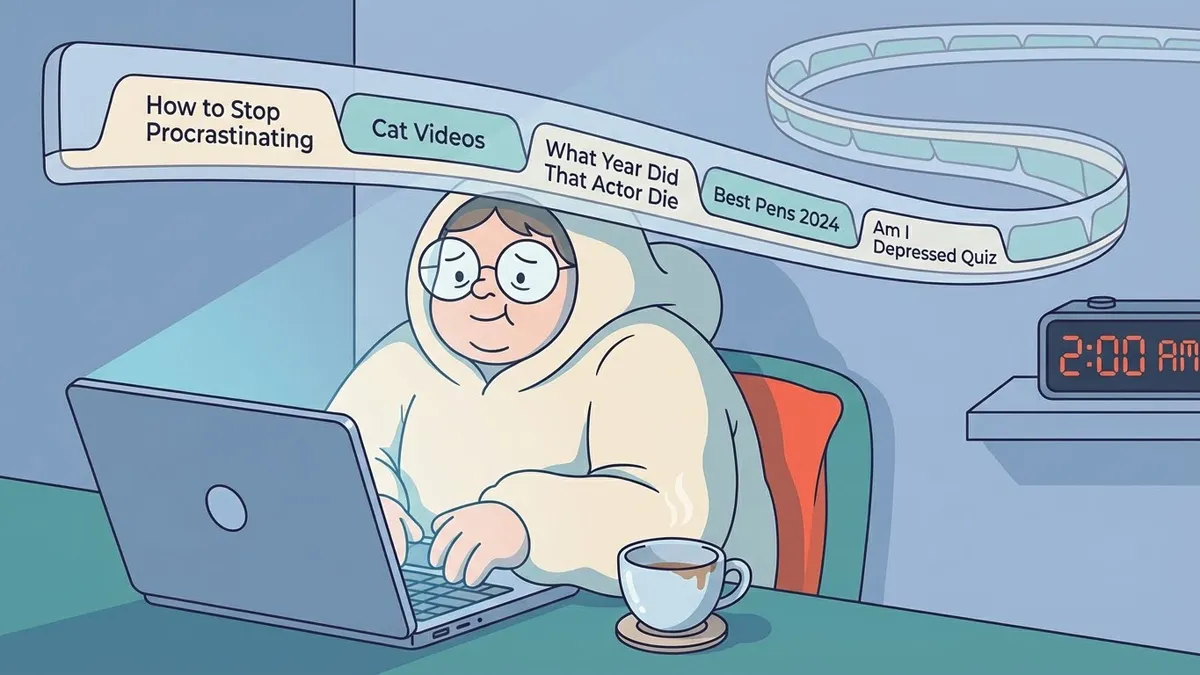
The evolved form. Characterised by having seventeen browser tabs open, three half-read books on the nightstand, and a notes app full of “brilliant ideas” that will never be touched again.
Distinguishing features: haunted eyes, impressive collection of domains that “will definitely become something,” and the unique ability to feel both overwhelmed and bored.
Here’s the uncomfortable truth: somewhere along the evolutionary path, we traded the ability to finish things for the ability to imagine endless possibilities. The caveman had one project and finished it because what else was he going to do? You have infinite options, infinite distractions, and infinite excuses.
Evolution gave us bigger brains. It didn’t give us bigger follow-through.
Why We Don’t Finish
Let’s drop the jokes for a minute.
If you’ve got a graveyard of abandoned projects, it’s not because you’re lazy. Lazy people don’t start things. You start plenty. That’s ambition. That’s creativity. That’s a real strength.
The problem is almost always one of these:
1. The project stopped being fun, and you never powered through.
The first 80% is exciting. You’re building, creating, seeing progress. The last 20%—the polish, the edge cases, the “making it actually work properly”—is tedious. And unlike a job, nobody’s paying you to push through the tedious bits.
2. You never defined “done.”
When there’s no finish line, you can’t cross it. If your project is “build an app” instead of “build an app that does X, Y and Z and nothing else,” you’ll keep adding features until heat death of the universe.
3. Perfectionism is pretending to be quality.
“I can’t ship it yet, it’s not good enough” sounds responsible. Often it’s fear wearing a sensible outfit. Version one is allowed to be rough. That’s what version two is for.
4. The thing you started isn’t the thing you actually want.
Sometimes a project stalls because, deep down, you don’t care about finishing it. You cared about starting it. The idea was exciting. The reality isn’t. That’s okay to admit.
What Actually Works
Alright, practical bit. Skip if you want — I’m not your mum.
1. Define “Done” Before You Start
Before you write a single line of code or make your first brushstroke, write down what “finished” looks like. Make it specific. Make it minimal. If you can’t describe the finish line, you’ll never reach it.
“Build a website” is not done. “Build a one-page website with my bio, three portfolio pieces, and a contact form” is done.
2. Cut Your Scope in Half. Then Again.
Whatever you think the minimum viable version is, it’s probably still too big. Cut features. Be ruthless. The graveyard is full of projects that died waiting for “one more feature.”
Ship the skeleton. Add muscles later.
3. Do the Boring Bits First
While you’ve still got momentum from the excitement of starting, attack the parts you know you’ll hate. Documentation. Testing. That fiddly responsive design. Use your early energy on the stuff that’ll kill you later.
4. Set a Public Deadline
Tell someone. Post it online. Book a launch date. Whatever works. Social pressure is embarrassing and effective.
“I’ll finish when it’s ready” means never. “I’m launching next Friday” means Friday.
5. Ship It Ugly
A finished ugly thing beats an unfinished beautiful thing. Every time. You can iterate, improve, polish after you ship. You can’t iterate on something that doesn’t exist.
The first version of everything is embarrassing. That’s fine. Ship it anyway.
6. Time-Box, Don’t Task-Box
“Work on this for one hour” is better than “finish this feature.” The hour ends; you stop. No guilt. No open-ended commitment. Stack enough hours and the thing gets done.
Alternatives That Sometimes Work Better
- If you’re energised by novelty: Work on multiple projects in rotation — Monday is Project A, Tuesday is Project B. Structured variety, not chaotic abandonment.
- If finishing feels impossible: Ship micro-projects first. A weekend project. A one-page thing. Build the finishing muscle on something small.
- If it’s been months: Maybe it’s time to archive with dignity. Not every project deserves to be finished. Some were stepping stones to better ideas. Let them go.
Resources That Might Actually Help
These are affiliate links. I might get a small cut if you buy them. That said, buying books about finishing won’t finish your project. Only you can do that. But these are genuinely good.
Defeat the Resistance
Steven Pressfield calls it “Resistance” — that invisible force that stops you from finishing. It’s not laziness. It’s not lack of talent. It’s a real thing that fights you every day, and this book teaches you how to fight back. Short, punchy, and weirdly motivating. Fair warning: you might feel personally attacked.
The War of Art: Break Through the Blocks and Win Your Inner Creative Battles

Learn How to Actually Finish
The title says it all. Jon Acuff wrote an entire book about why we don’t finish things and how to actually do it. Spoiler: perfectionism is the enemy, and cutting your goals in half is surprisingly effective. This is basically the book version of this post, but with more research and fewer jokes about unicorns.
Finish: Give Yourself the Gift of Done

A Closing Thought
Look. I get it. Starting things is fun. Finishing things is work. And the world makes it very easy to start new things and very hard to focus on old ones.
But here’s the thing about finishing: it changes how you see yourself.
Every abandoned project whispers that you’re someone who doesn’t finish. Every completed project—even a small one, even an ugly one—proves you can. That proof adds up. It shifts something in your brain. You start to trust yourself more.
So maybe pick one. Just one from the pile. Not the biggest one. Pick the one you could actually ship in a week if you just sat down and did it.
And finish it.
Not because it’ll change the world. Because it’ll change how you see yourself.
Or don’t. Keep them all in their natural state of incompleteness. They’re very happy there.
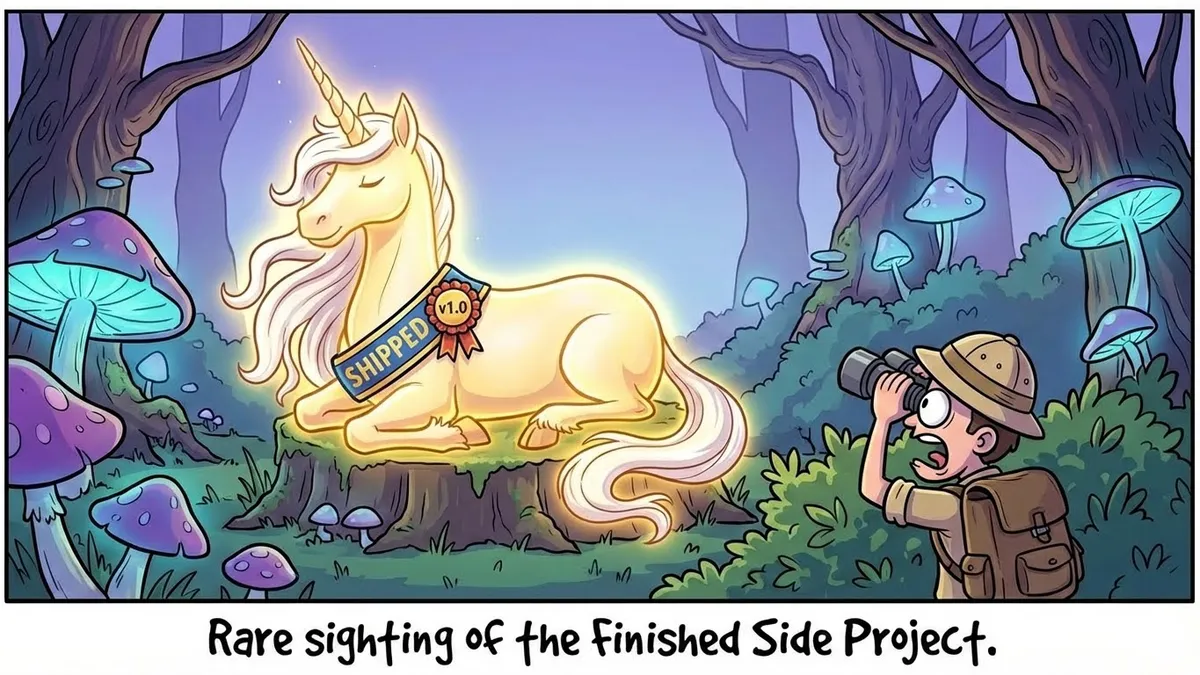
Rare footage of a project that was actually completed: