How to Recover from Burnout

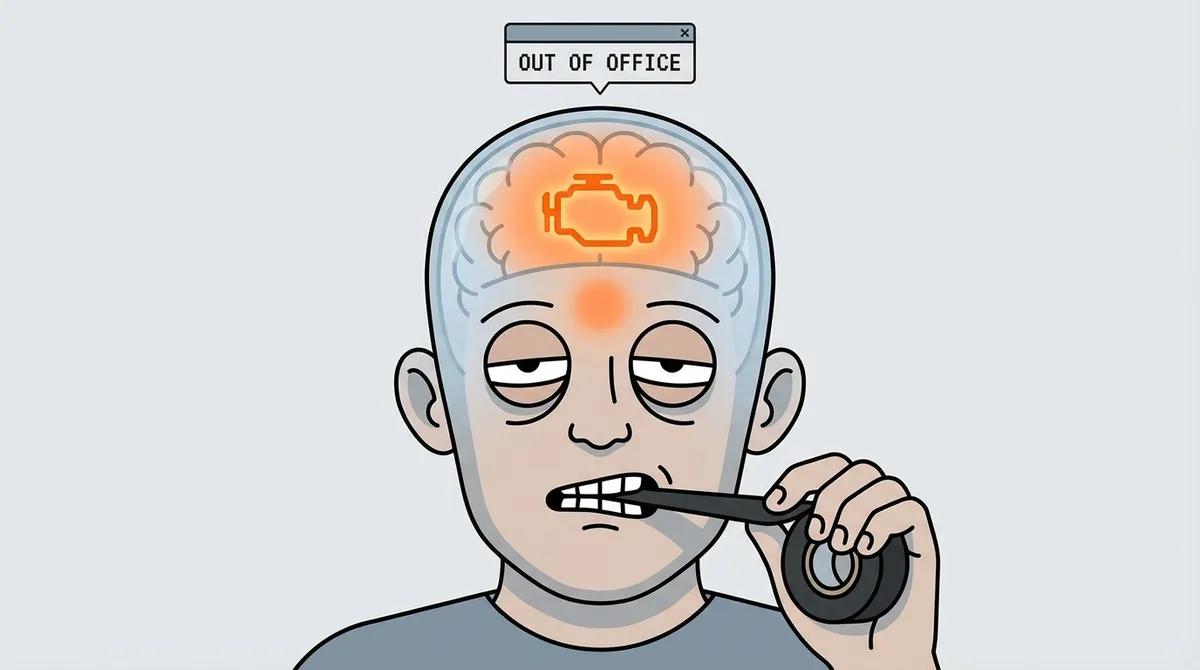
The following is an automated response from your brain. For urgent matters, please contact [literally anyone else because I’ve lost the will to respond].
Shutting down non-essential services (personality, patience, the ability to formulate sentences).
Introduction: The Check Engine Light
If you are reading this, your internal “Check Engine” light has been on. Until now, your strategy has been the same one used by dodgy car sellers: put a piece of black tape over the light and hope nobody notices.
⚡ The Burnout Emergency Checklist (TL;DR)
If you are currently staring at a wall unable to move:
Stop. Literally stop what you are doing. You cannot drive a broken car.
Say No. Cancel one thing today. Just one. Feel the relief.
Close Tabs. Your brain is leaking RAM. Close the mental tabs.
Eat. Fuel the machine. Something with protein, not just sugar.
Sleep. It is not “wasted time.” It is system maintenance.
Chapter 1: The Circle of Life (Corporate Edition)
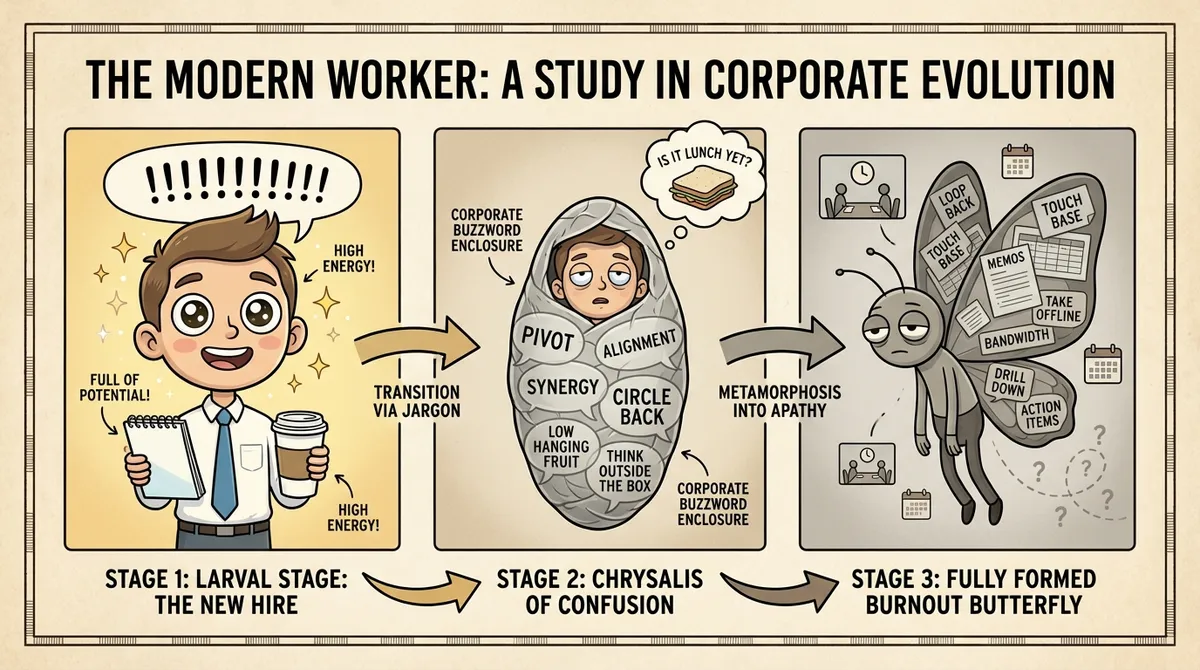
We observe the majestic lifecycle of the Modern Worker.
It begins in the Larval Stage: The New Hire. Bright-eyed. Eager. Carrying a notebook and a belief that “we can really make an impact here.” They volunteer for committees. They use exclamation marks sincerely!
Then, the Chrysalis of Confusion: The first restructure hits. The strategy pivots. The “impact” is now “alignment.” The worker retreats into their shell, learning to nod while thinking about lunch.
Finally, they emerge as the Fully Formed Burnout Butterfly. Beautiful in their cynicism. They have no idea what the company is trying to achieve anymore, and they no longer ask. They simply float from meeting to meeting, spreading apathy and “looping back” until retirement.
Chapter 2: Field Notes on Homo Exhaustus
Let us observe the burnout creature in its unnatural habitat.
The Doom-Scroll
The creature attempts to “relax.” Logic suggests a nap or a walk. Instead, it lies frozen on the couch, bathing in the blue light of a glowing rectangle, scrolling through news about global catastrophes. It is stressed, yet it cannot look away. It is “relaxing” with the intensity of a bomb disposal technician.
The Multitasker
Watch as it attempts to be productive. It opens three screens. It replies to a Slack message while half-watching a training video and checking email on its phone. Result: It has achieved absolutely nothing. It has merely moved data from one screen to another while its soul slowly evaporates.
Pack Behaviour: Social Withdrawal
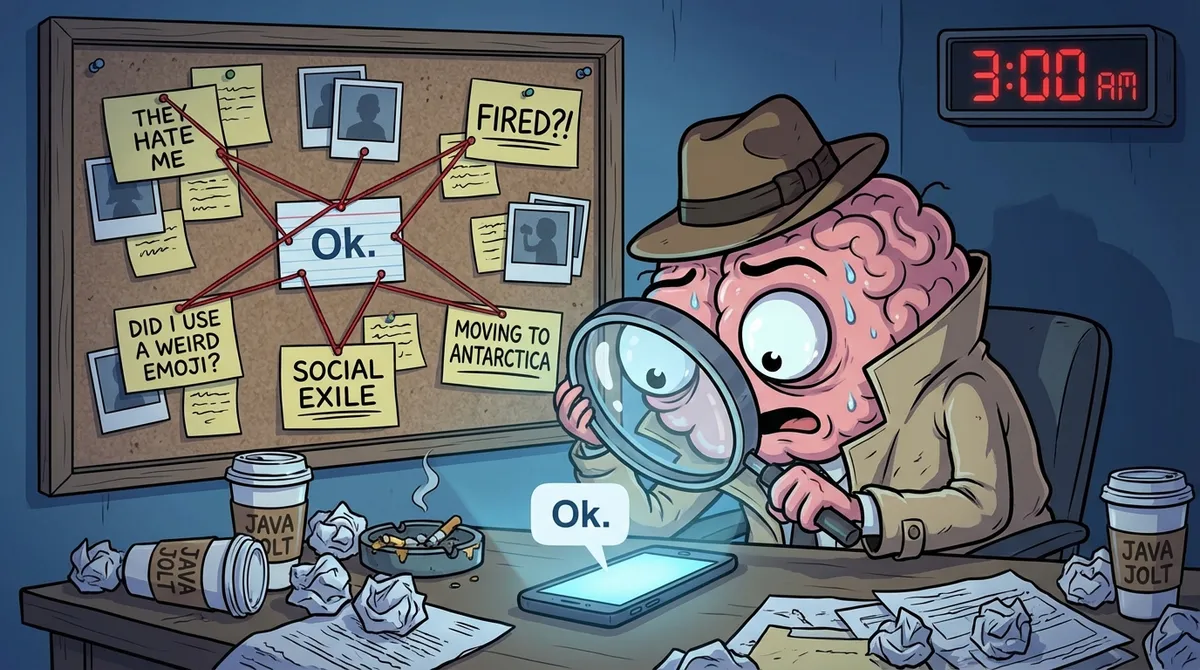
Once a thriving member of group chats, the burnt-out human now watches messages accumulate like autumn leaves. Ping. “Dinner next week?” Ping. “Look at this meme!” The creature stares. It wants to go. It loves the pack. But the energy required to type “Sounds good!” is unavailable. It can only muster a single thumbs-up.
Chapter 3: The Productivity Cargo Cult
You have likely tried to fix this. You have turned to the Productivity Gods.
In World War II, Pacific islanders saw planes drop cargo. When the war ended, the planes stopped. So, the islanders built life-size decoy planes out of straw and bamboo, hoping to attract the cargo back. These were “Cargo Cults.”
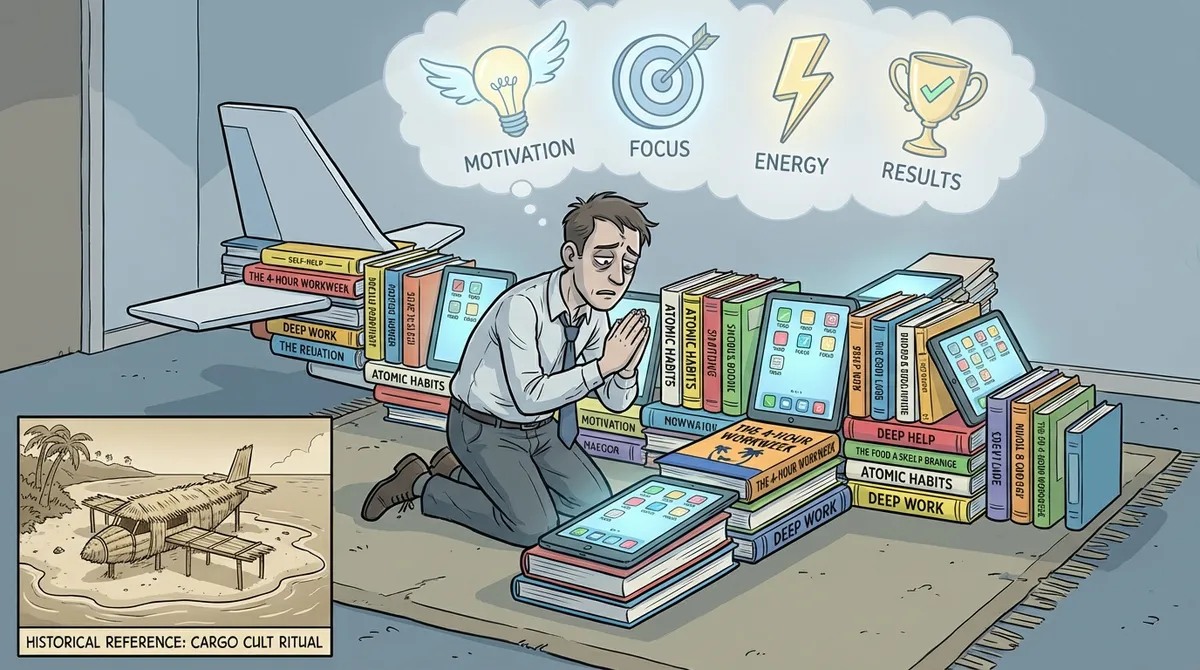
You are doing the same thing.
You are building straw airplanes out of Bullet Journals, Morning Routines, and Pomodoro Timers. You are performing the rituals of productive people—rising at 5 AM, drinking the green sludge, colour-coding your calendar—hoping that energy will magically drop from the sky.
But the sky is empty. Because you don’t need a better planner. You need a nap.
What Actually Works
Okay, let’s step away from the straw plane. The documentary crew is packing up. Here is the boring, unsexy truth about getting your brain back.
1. The Myth of “Pushing Through”
You think if you just push harder, you’ll break through the wall and find energy on the other side. Truth: You pushed. You went straight through the wall… and out the other side, where nothing makes sense and you’re crying because the supermarket changed the aisle layout. Stop pushing. You are not a shimmering hero of productivity. You are a biological organism that requires fuel.
2. The Guilt Hangover
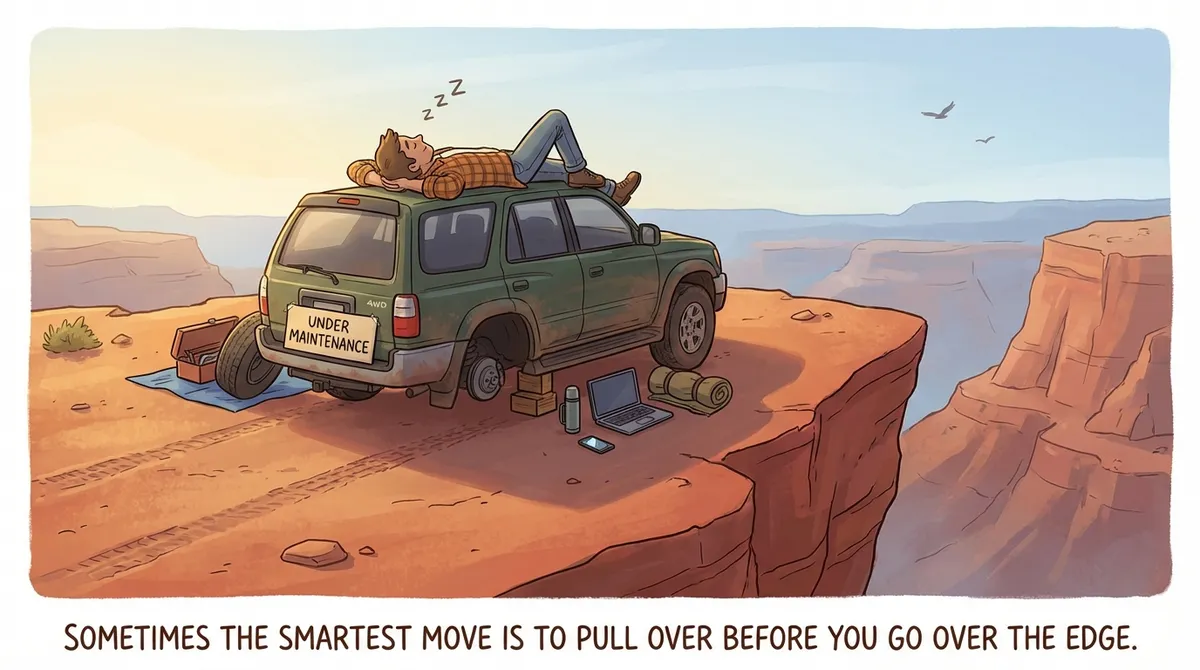
You finally take a day off. But you spend the entire day feeling guilty about not working. Result: You return to work just as tired, but now with added self-loathing. Fix: Resting with guilt is not resting. It is just suffering in a horizontal position. You have to aggressively permit yourself to be useless. Tell your brain, “We are closed for maintenance.”
3. Sleep Without Recovery
“But I slept for 8 hours!” And you woke up feeling like you had been tumbled in a dryer full of rocks. This is because physical sleep is not the same as mental recovery. If your brain is running a marathon while your body is unconscious, you will not wake up refreshed. The Fix: Brain dumping before bed. Write down every worry. Tell the paper, “You hold this. I am going offline.”
4. Tiny Resets Beat Big Overhauls
You don’t need a “Life Reboot.” You don’t need to move to a goat farm (though it sounds nice). You need Tiny Resets:
- Close tabs. (All of them. Yes, even that one.)
- Walk outside for 10 minutes without headphones.
- Eat a lunch that doesn’t involve typing.
- Say “No” to one thing today.
Recommended Resources
If you need permission to stop, these might help:
-
“Burnout: The Secret to Unlocking the Stress Cycle” by Emily Nagoski – The science of why you feel like garbage and how to complete the biological stress cycle.
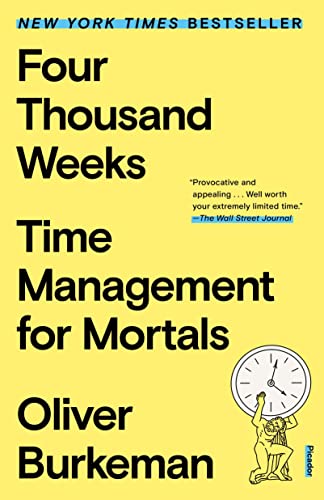
Four Thousand Weeks
-
“Four Thousand Weeks” by Oliver Burkeman – A book about time management for mortals. Spoiler: You won’t get it all done, and that’s okay.
Four Thousand Weeks
-
A Weighted Blanket – It’s like a hug, but without the social obligation to talk to the person hugging you.
Wemore Fleece Weighted Blanket

As an Amazon Associate, we earn from qualifying purchases. This means that if you purchase a product through one of our links, we may receive a small commission at no extra cost to you.
Closing Transmission
We urge you to look at the dashboard. The light is flashing. The battery is low.
You cannot drive a car at 100km/h while simultaneously changing the tires and repainting the chassis. Pull over. Turn off the engine.
The email will be there tomorrow. The group chat will wait. The world will keep spinning without your constant supervision.
Step away from the vehicle.